

Written by Kelley De Polt
If you asked ten people what a Multi-hazard Early Warning System (MHEWS) Platform is or should do, you would likely get ten different answers. This is exactly what my Short-Term Scientific Mission (STSM) “MHEWS Observatory – A High-Level View of European Early Warning Platforms” set out to explore. Broadly, these platforms are digital infrastructures that host and facilitate user interaction, though sometimes a platform is a simpler technical report or output, and sometimes it is a complex, operational portal. Global initiatives under UNDRR and WMO’s EW4All have made strong progress in assessing MHEWS, though there is not yet a centralised, consistently derived inventory of the platforms that facilitate user access to the warnings themselves. The Observatory sets out to begin filling this gap, firstly by scoping out what a platform actually is in practice, then by building a transferable protocol to evaluate platform capabilities, and finally by applying that protocol across the European hydro-meteorological warning landscape.
Initial Scoping
I began the STSM with a review of how the term “platform” is used in the context of MHEWS, across UNDRR and WMO documentation, alerting agency materials, and academic literature. This resulted in a working typology in which data ingestion, risk assessment, and communication practices emerged as the core elements. Ultimately, however, no single definition emerged. In practice, platforms ranged from interactive portals offering both warnings and general risk information (e.g. the DWD Naturgefahrenportal, Germany), to dashboard-style set-ups that even include space weather information (e.g. the METEO-IMGW application, Poland), to also include more condensed graphics highlighting temporal evolution that provides all essential information at a glance (e.g. the Croatian Meteorological and Hydrological Service warnings page).
Building the Protocol
Given the breadth of domains involved in EWS creation and dissemination, I could not develop the protocol alone and needed a complete picture. I therefore reached out to each working group (WG) to draw on their expertise. I first assessed their objectives in the Memorandum of Understanding (MoU) to build a preliminary collection of review points relevant to their outcomes and objectives, then held separate validation meetings to check these points and define further ones. Surprisingly, three cross-cutting themes emerged consistently across the meetings: [1] the transition between short-term warnings and long-range guidance; [2] interoperability between institutions with different mandates; and [3] the linkages between risk and actionable response. From this point, the protocol settled into five sections: [1] Platform Identification and Access; [2] Multi-hazard Typologies and Representation; [3] Forecasting, Modelling, and Predictability; [4] Inclusion of Exposure, Vulnerability, and Impact; and finally [5] Warning Communication and Dissemination.
Realising the Vision at CMCC
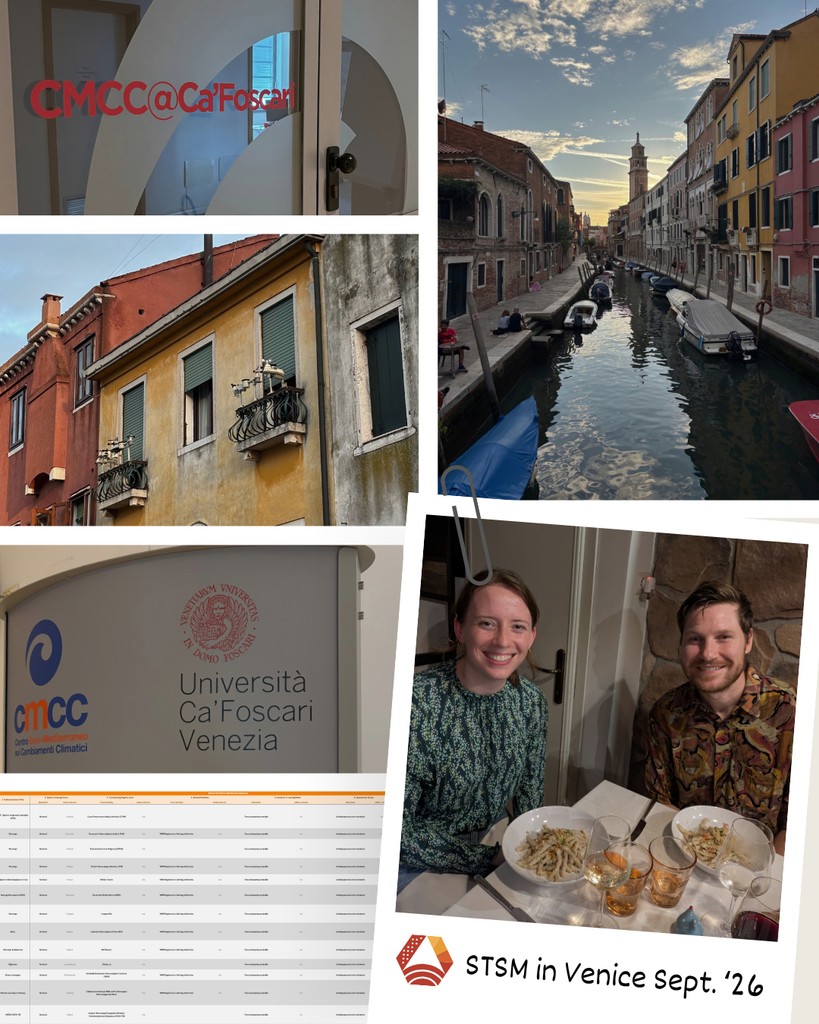
I visited the hosting institution, the Fondazione Centro Euro-Mediterraneo sui Cambiamenti Climatici (CMCC) at Ca’ Foscari (Venice, Italy), for one week this September, and it was here that the protocol found its final shape. This happened particularly through a virtual Gap Analysis Round Table, at which the three cross-cutting themes formed the main discussion point. There, my host, Timothy Tiggeloven, and I were able to reconnect with the protocol contributors, settle on the final vision, and raise any remaining elements for consideration.
What We Could See through the Observatory
Using the finalised protocol, I built version 1.0 of the MHEWS Platform Observatory, covering the five sections above and 31 sub-attributes in total. Nearly thirty hydro-meteorological warning platforms were identified, spanning both national and continental initiatives. Assessing them proved harder than first anticipated as many platforms provided only limited outward-facing information about their specifications, so the “review” often became a piece of detective work. No two platforms were quite the same, each tailored to its own user base and context. This was most visible in the approach to warning colour coding, where some platforms shared broadly similar conventions and others took a completely different approach. Version 1.0 of the Observatory is available in the the ANTICIPATE library, alongside a form for further contributions and edits from the community, to ensure its completeness and its value as a lasting resource.
Lessons Learned
The primary lesson learned sat more in the realm of professional development than technical skill. Through coordinating input across the four WGs, a roundtable discussion, and my own views and ideas, I found that my leadership and coordination skills were developed just as much as the scientific gap this STSM set out to address. I also learned how to condense many inputs and viewpoints into a coherent, complete comparison. Perhaps just as importantly, I can no longer view this work in isolation from other efforts around the scope of EWS, particularly when seen through an operational and practical lens.
Contribution to ANTICIPATE
ANTICIPATE as a whole, in the hope that WG1 would see the interdependencies at play in practice, WG2 would gain a clearer picture of capability gaps, WG3 would uncover what exposure and vulnerability data is available or used in practice, and WG4 would have relevant findings and a starting point for its products. The next step is to bring these insights into a peer-reviewed manuscript, ultimately advancing the standardisation and comprehensiveness of MHEWS across Europe by linking research advances to operational systems.
I am very grateful to my hosts at CMCC (including the many nice espresso breaks with colleagues), to the WG leads who worked through the protocol’s creation with me, and to the ANTICIPATE COST Action for making this visit possible. I would highly recommend this opportunity to future applicants, I am sure it will have a lasting effect and left me feeling truly empowered and encouraged as an early-career researcher