

Written by Andra-Cosmina Albulescu
My Short-Term Scientific Mission (STSM) at VU Amsterdam aimed to review the effectiveness of operational Multi-Hazard Early Warning Systems (MHEWS) across four dimensions: disaster risk knowledge, governance structures, levels of development (system maturity), and community uptake. The review relied on colour-coded mind maps as a tool to visualise and analyse 42 interconnected items of effectiveness evidence. In collaboration with my host, Marleen de Ruiter (co-lead of ANUnTICIPATE WG4), I examined what works, what fails, what is controversial, and what goes undocumented in terms of MHEWS effectiveness at different spatial scales. Based on these findings, we developed several design and implementation principles for the next generation of MHEWS, directly addressing the need to learn from best practices in order to advance MHEWS.
During the two weeks of my stay here, I followed the five-step work plan we had established. The first two phases (identification of operational MHEWS to review and effectiveness evidence collection) were completed prior to my arrival, allowing the STSM itself to be devoted to larger tasks. The reviewed MHEWS were selected based on insights from the stakeholder survey conducted within WG4 and 5, and examples from the literature. The 42 items of effectiveness evidence were elicited from scientific literature and key policy reports by WMO, UNDRR, EW4all, and others. For each of these items, we collected evidence of effectiveness and gaps from a wide range of sources: peer-reviewed papers, MHEWS internal documentation and review reports, legal frameworks, news reports, etc.
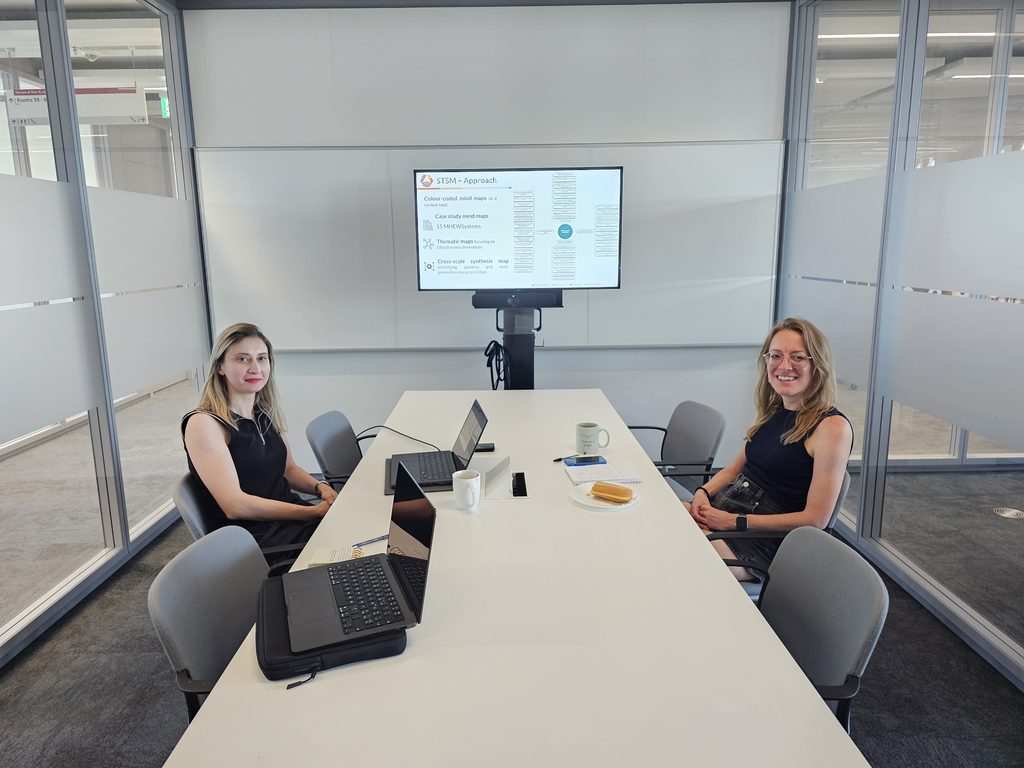
The first week was dedicated to analysing the effectiveness evidence for the 15 selected MHEWS against the 42 items and designing three sets of mind maps: 15 case-study maps for individual systems, 4 thematic maps for each of the effectiveness dimensions, and a cross-scale synthesis map integrating the whole. These 20 mind maps were colour-coded to depict effectiveness evidence, contested aspects (mixed evidence of effectiveness and gaps), failure points, and undocumented aspects, for systematic comparison and direct identification of priority areas for improvement in MHEWS. During the second week, we formulated several design and implementation principles to guide MHEWS improvements. Also, the maps were integrated into an AI-powered interactive dashboard that will be made freely available online as one of the first tangible outputs of the ANTICIPATE network.
There is a strong sense of satisfaction in how my STSM unfolded: each day of work brought progress building on previous ones. Marleen and I held meetings every few days, frequently alongside the co-lead of WG4, Robert Šakić Trogrlić. Our joint effort produced the three outputs we had planned: 1) a three-tiered mind map-based review on the effectiveness of MHEWS, 2) a set of documented design and implementation principles for next-generation MHEWS derived directly from the cross-scale synthesis mind map, and 3) a freely available AI-powered interactive dashboard integrating the mind maps.
Looking back on the STSM, my host and I both have come to appreciate how much a research visit of this kind can do, whether to start a collaboration or to consolidate an existing one. Benefiting from a collaboration already in place, this shared vision made the work feel natural from the start, and productive rather than tentative. One shared lesson was the value of making our thinking visible, as demonstrating the evidence as mind maps surfaced patterns and gaps that neither of us had noticed just by reading. Surprisingly, some of our clearest insights came not from planned sessions but from the enjoyable, unstructured conversations in between. We also mapped out the next steps in detail, and it’s exciting to have a clear path ahead: developing the results into a scientific paper and presenting them at prominent conferences, such as the EGU General Assembly 2027. Over the coming months we will continue writing the paper through online meetings, coordinating with other key ANTICIPATE members.
This STSM provided me with renewed motivation to advance research on MHEWS and disaster risk reduction, and with a real sense of connection. I am also glad I could contribute to ANTICIPATE’s mission, as the STSM speaks directly to the aims of WG4: it provides evidence-based input for the conceptual framework for extended-range multi-hazard early warning set out in ANTICIPATE’s RCO2 roadmap (D4.3). By analysing existing MHEWS and their effectiveness in a structured, evidence-based way, the work becomes a foundation for two things at once: drawing out transferable design principles for future MHEWS, and refining ANTICIPATE’s own products. And the AI-powered dashboard developed from our results offers something that will outlast the visit itself: a living, openly accessible resource for researchers, practitioners, and policymakers.
When evidence is made visible, new possibilities for understanding and action emerge. The mind maps, principles, and dashboard become really valuable due to what they make possible next: turning scattered evidence into improved MHEWS that reach the communities depending on them. I left Amsterdam energised to keep building within the ANTICIPATE network.