

Written by Eloise Matthews
From Somerset to Delft: Towards understanding and attributing compound flooding
In September, I spent three weeks in the Netherlands on an ANTICIPATE Short-Term Scientific Mission (STSM), hosted by Deltares in Delft. My aim was to advance flood modelling capabilities for investigating the compound flooding of the Somerset Levels in southwest England in winter 2013-14, by working directly with flood modelling experts. This work forms part of the Horizon Europe COMPASS project which is exploring attribution frameworks for compound and complex extreme events.
The UK Met Office have been using an open-source modelling framework developed by Deltares, which uses their SFINCS (Super-Fast INundation of CoastS) model, to simulate the Somerset flooding event. By comparing factual and counterfactual – the latter reflecting a past world without human-induced climate change – simulations, it is possible to investigate the attribution of the event to climate change.
Before the STSM, my work had focused primarily on the role of the prolonged and compounding rainfall during that winter brought by sequential storms. As well as facilitating technical progress, my visit to Deltares also provided an opportunity to broaden this perspective to consider the potential coastal contribution to flooding, including learning how to vary model sea level boundary conditions, and how to include flood defences. This directly supports ANTICIPATE’s aim of improving our understanding of multi-hazard events and their changing risks.
What did I get up to?
A key aim of the visit was to expand the usability of the modelling workflow by developing its compatibility to be run in a Microsoft Azure cloud computing environment. By mid-way through the visit, we had successfully run a template modelling workflow for Somerset on Azure and had a clear picture of key technical challenges and required workarounds to discuss with developers. Implementing these workarounds enables me to run model simulations independently back at the Met Office, and work towards producing results to contribute to a journal paper and as material for the project hackathon to be hosted at Deltares in February 2027.
I had initially intended to complete a larger set of factual and counterfactual simulations and begin analysing differences in flood extent and depth during the STSM. However, once the first simulations were running on Azure, they highlighted uncertainties in how the Somerset Levels environment was represented within the model. In particular, I was investigating the use of higher-resolution elevation and bathymetry datasets, the inclusion of flood defences, and improvements to river representation, all of which influence how water moves through the system and therefore affect the simulated flooding.
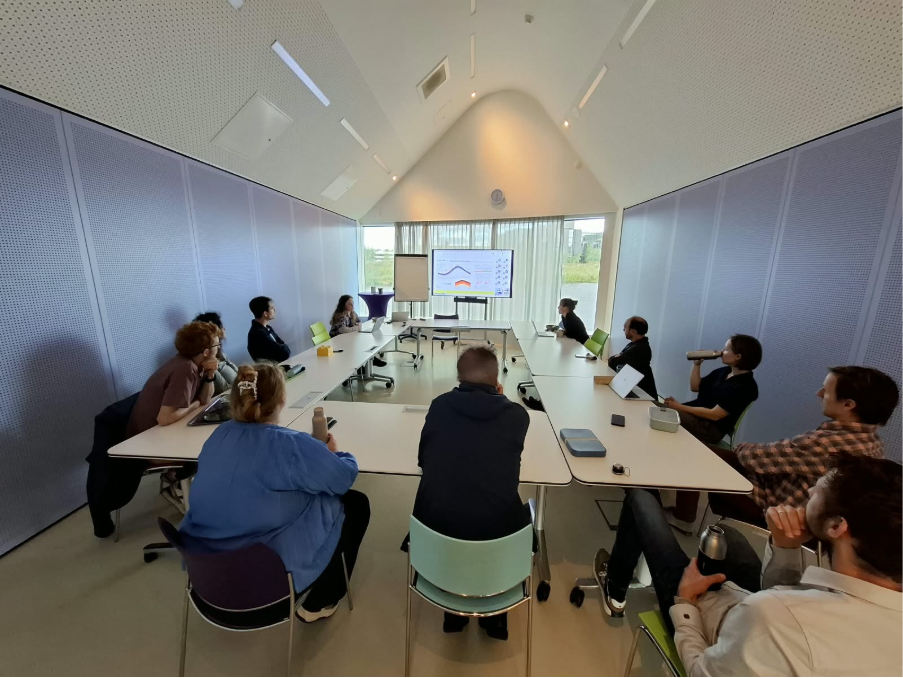
As the visit progressed, we spent increasing amounts of time examining and clarifying these aspects of the model configuration, inspecting the underlying geographical datasets, testing individual model components and investigating unexpected behaviour. This led to a useful and necessary shift in priorities. Rather than trying to produce a larger number of simulations, we concluded that improving the representation of the event would provide a more robust foundation for subsequent analysis. These tests highlighted areas requiring further refinement before the final simulations are carried out.
Another key objective of the STSM was knowledge exchange. The modelling workflow is complex, and working directly with colleagues who develop and routinely use the software accelerated my understanding significantly. Over the three weeks, I developed my technical skills and became much more confident in diagnosing model problems, examining spatial datasets and understanding how changes to the model setup may affect the final simulation. Having model developers and experienced users just a desk away made a huge difference to the progress I was able to make. Similarly, I was able to share my learnings from my work to date for making the model compatible with Azure, and contextual knowledge of the Somerset Levels environment.
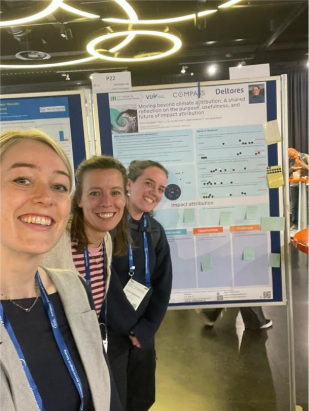
The visit also coincided with the European Meteorological Society Annual Meeting in Utrecht, where I presented the Somerset work in the “Attribution of extreme weather events and their impacts” session; it was extremely valuable to meet and discuss the work with other attribution scientists. Back at Deltares, I also gave a lunchtime seminar, which prompted further discussions on model validation, the role of flood defence maintenance, and the usefulness of different metrics for calculating attribution results.
What comes next?
The STSM has left me with both a substantially improved model setup and a clearer set of scientific questions. My next steps are to complete the model improvements identified during the visit, run a systematic set of experiments combining different rainfall and sea-level conditions, and examine the relative contributions of inland and coastal drivers to the Somerset floods. These will allow me to investigate whether coastal sea level made a meaningful contribution to the Somerset flooding, how that compares with the influence of rainfall, and how those contributions have changed with a warming climate. These results will also facilitate discussions about how this type of modelling can inform flood preparedness and resilience.
More broadly, the visit strengthened links between the Met Office and Deltares beyond the current COMPASS project. It was invaluable to learn directly from the model’s developers, share expertise across organisations and create a stronger foundation for future collaboration. Rather than simply providing three weeks in which to generate model results, the STSM gave me the time and access to expertise needed to question how the model works and improve the foundations for my analysis, which will ultimately make the project’s conclusions more meaningful.