

Written by Charlotte Lyddon
Coastal and estuarine flooding is shaped by interacting drivers including river flow, precipitation, tides and storm surge. Their magnitude, timing, duration and dependence can all affect the resulting flood. Compound-event research has become increasingly sophisticated at characterising these interactions, while process-based models can simulate their physical consequences. But the link between the two remains less clear. How can information about changing compound events be translated into physically meaningful information about flood hazard? I spent two weeks with the Department of Compound Environmental Risks at the Helmholtz Centre for Environmental Research (UFZ) in Leipzig exploring this question.
My research focuses on compound flood hazard in UK estuaries, using process-based modelling and climate projections to investigate how interacting riverine and coastal drivers produce flooding. At UFZ, I brought this perspective together with expertise in compound-event statistics, climate attribution and large climate-model ensembles.
The STSM began with a literature review spanning compound-event statistics, climate projections and attribution. Compound-event studies can identify changes in magnitude, frequency, dependence, lag, duration and sequencing. Flood models can show how combinations of these drivers translate into flood depth, extent and duration. But a statistically significant change in a compound event does not necessarily mean a corresponding change in physical flood hazard.
This prompted me to look critically at the climate information used to drive my own hazard models. The projections I have used are based on a single climate model, with uncertainty represented by a 12-member perturbed-parameter ensemble. They provide physically consistent marine and fluvial information at the resolution needed for flood modelling, but do not capture the full structural uncertainty across climate models. I therefore used CMIP6 to ask a complementary question: how does the climate model underlying these high-resolution projections compare with the wider range of climate-model behaviour?
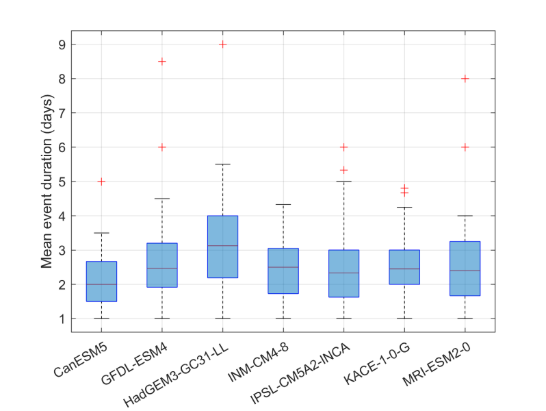
A direct comparison was not possible because global models do not necessarily provide the same high-resolution marine and fluvial variables. Instead, I compared variables available across models at a common, coarser resolution. One analysis examined daily sea-level pressure across six CMIP6 models, focusing on low-pressure intensity, the frequency and persistence of unusually low-pressure conditions, and rapid pressure changes (Figure 1). I then considered where the climate model underlying my usual projections sits within this wider range. This highlighted a fundamental trade-off: ensemble breadth versus physical detail. Multi-model ensembles provide a broader representation of climate-model uncertainty, but may not contain the variables or resolution needed to force a local hazard model. High-resolution projections provide greater physical detail, but sample a more limited range of climate-model uncertainty.
Further to this, I discussed hydrological modelling, interpretable machine learning and compound drought extremes with researchers across the group, joined the weekly research meeting, and presented a seminar on coastal and estuarine compound flooding. These conversations helped me consider how the climate-to-hazard problem applies across different environmental systems.
Together, the literature, CMIP6 analysis and discussions led to a more fundamental question: which characteristics of a compound event actually matter for physical hazard?
For an estuary, a change in the statistical dependence between river discharge and storm surge may be detectable. But its effect on flooding depends on when the events occur, how long they last, their magnitude, and how the estuary responds to them. This suggests that compound-event analysis should not focus only on characteristics that are easiest to quantify statistically. Instead, physical hazard response should help determine which characteristics are most important to investigate in climate data. This is the basis of a conceptual approach I am now developing to connect compound-event characterisation with physical hazard assessment. The aim is to identify the event characteristics that control hazard response, and then examine how those characteristics are changing through climate attribution and future projections.
There is a clear research path from here. The next step is to extend the CMIP6 analysis to additional variables, particularly precipitation. Targeted process-based modelling could then test how changes in the statistical relationship between river flow and storm surge translate into changes in flood depth, extent and duration. Ultimately, I would like to apply the approach to a real estuary from climate drivers through to physical hazard.
The STSM has provided the basis for a perspective paper and a foundation for continued collaboration between the University of Liverpool and UFZ. It has also opened up potential longer-term research directions, including dedicated modelling work through a PhD or externally funded project.
The work contributes directly to ANTICIPATE’s Working Groups. It raises the question of which event characteristics are worth predicting in the first place, with implications for extended-range prediction. The CMIP6 comparison provides an initial assessment of how a high-resolution projection dataset sits within broader climate-model uncertainty. The developing conceptual approach also offers a potential route from compound-event databases towards physical impacts such as flood depth, extent and duration, relevant to WG3 and hazard databases.
For me, the main outcome of the STSM is a clearer research direction: from identifying changes in interacting climate extremes to understanding which of those changes actually matter for physical hazard.
I’m very grateful to Jakob and Emanuele for hosting me, to everyone in the Department of Compound Environmental Risks for their time and ideas, and to the ANTICIPATE COST Action for making the visit possible. I’d encourage other early-career researchers to go for it.