

Written by Gabriel Narváez Campo
Objective and motivation
The main objective of my Short-Term Scientific Mission at the Swedish Meteorological and Hydrological Institute (SMHI) was to explore how artificial intelligence can improve seasonal streamflow forecasts while retaining the information provided by a physically based hydrological model. The visit built on machine-learning post-processing work previously developed at CNRM-Météo-France, but provided the opportunity to test the approach in a new modelling environment and to address a more demanding question: can a correction learned from monitored river basins be transferred to basins that were not used to train the model? This question is particularly relevant for large-scale forecasting systems, where observations are unevenly distributed and local recalibration is not always possible.
Work carried out during the STSM
During the first part of the visit, I worked closely with Ilias Pechlivanidis and Yiheng Du to refine the scientific question, review the available World-Wide HYPE (WW-HYPE) data and define a robust evaluation strategy. The original proposal envisaged a Europe-focused test case. During the STSM, scientific discussions and access to the global WW-HYPE framework led us to broaden the experiment to a global domain. This allowed the method to be tested across a much wider range of climates and hydrological regimes, while keeping the original aim of developing transferable post-processing for extended-range streamflow forecasts.
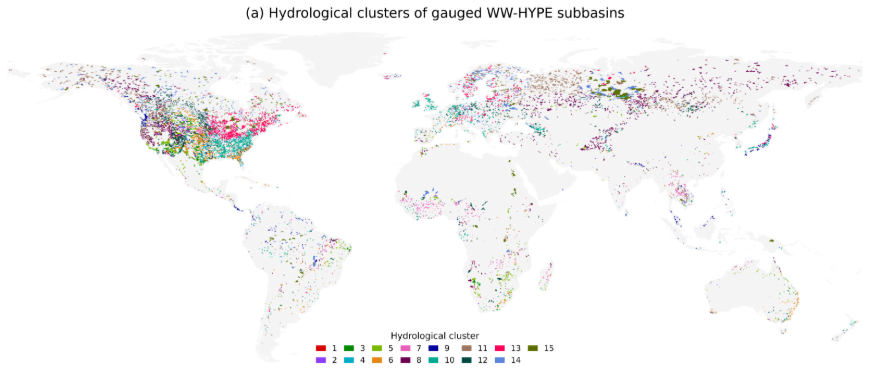
A major part of the work focused on hydrological regionalisation. More than eleven thousand gauged basins were characterised using hydrological signatures describing features such as typical flow magnitude, variability, persistence, baseflow contribution and high- and low-flow behaviour. Basins with similar hydrological functioning were grouped into 15 clusters. These groups were then used to design a spatial training and evaluation strategy in which all major hydrological regimes were represented, while the final assessment stations remained completely excluded from model fitting.
We then developed and evaluated an XGBoost-based post-processing model. Rather than replacing WW-HYPE, the machine-learning component learns systematic differences between the raw seasonal forecast and observed streamflow and uses this information to adjust the forecast. The correction was evaluated across forecast lead times, seasons, hydrological regimes, continents and low- and high-flow conditions using deterministic and probabilistic verification measures. Compared with the initial work plan, comparisons with several simpler statistical correction methods were deprioritised so that more effort could be devoted to independent spatial transferability, hydrological regionalisation and a climatological benchmark.
Main outcomes and lessons learned
The results obtained during the mission are encouraging. The hydrologically informed post-processing consistently reduced streamflow forecast errors at stations that were not used for training, and the benefit remained visible through the seasonal forecast horizon. Improvements were particularly clear for systematic errors and low-flow probabilities. At the same time, the analysis revealed important limitations: gains were not spatially uniform, high-flow probability forecasts were more difficult to improve, and the forecast ensembles remained too narrow relative to the observed uncertainty. The regional analysis also showed how strongly the evaluation of transferable machine-learning methods depends on the availability and completeness of streamflow observations.
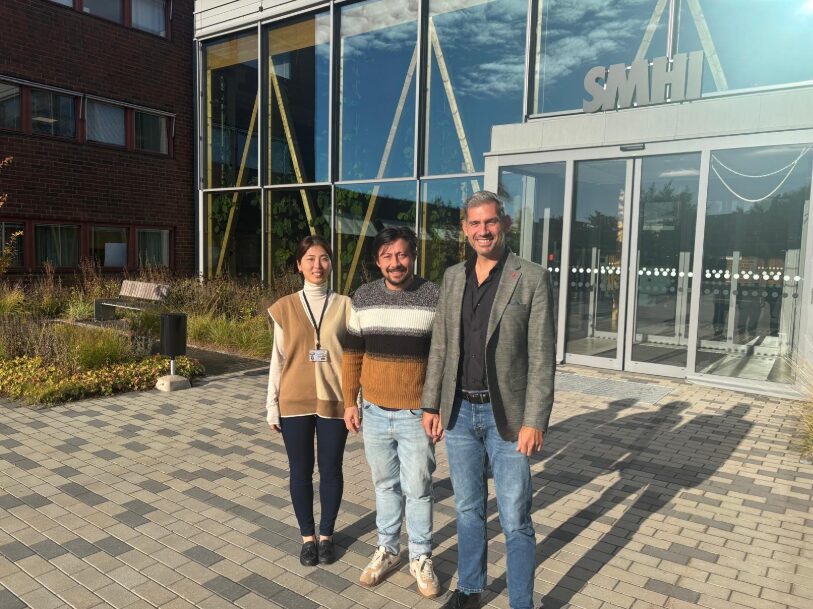
The most valuable aspect of the STSM was the direct scientific exchange behind these methodological choices. Discussions with Ilias and Yiheng helped move the work from a generic bias-correction exercise towards a hydrologically informed regionalisation framework with a clearer and more rigorous transferability question. I gained a deeper understanding of the WW-HYPE forecasting system, hydrological regionalisation and the practical challenges of evaluating large-scale seasonal forecasts. At the same time, the collaboration brought together SMHI expertise in global hydrological modelling and regionalisation with my experience in machine-learning post-processing and forecast verification. This combination was essential for identifying both the strengths of the approach and the cases where further development is needed.
Follow-up and contribution to ANTICIPATE
The mission has already resulted in a joint scientific manuscript that is currently under preparation on hydrologically informed machine-learning post-processing of global seasonal streamflow forecasts and its transfer to unseen basins. The immediate follow-up will focus on completing the remaining sensitivity analyses, consolidating the reproducible workflow and preparing the manuscript for submission. Further work will address ensemble calibration, high-flow conditions and transfer to data-sparse regions. Together, these activities support ANTICIPATE’s aims by connecting AI, process-based modelling and operational forecasting.